


Baraja Española: Playing with the Mexican/Spanish Card Deck
by Alex J. Coyne & Jude Goodwin © Gifts & Games for Card Players
Recently a friend and I were visiting Puerto Vallarta in Mexico. We had travelled by trimaran, enjoyed a snorkelling excursion, and were sitting on a beach under an umbrella sipping on margaritas when it came to me that we could play some cards. So I visited the little souvenir shed and sure enough they had a lovely deck which I promptly purchased. But when my friend and I attempted to play a game of Honeymoon Whist, we realized there was something very very different about this deck of cards!
Of course I went back to talk to the shopkeeper and she told me the cards were for playing Brisca. We didn’t know the game but I was determined to learn more once I returned home.
Spot the difference
The Mexican deck differs from the typical bridge or poker playing cards in the following ways:
Different Suits
Instead of Spades, Hearts, Diamonds, and Clubs, the Mexican deck uses four distinct, ancient symbols rooted in medieval society:
-
Oros (Coins / Gold): Represents the merchant class. (Roughly corresponds to Diamonds)
-
Copas (Cups / Chalices): Represents the clergy. (Roughly corresponds to Hearts)
-
Espadas (Swords): Represents the nobility and military. (Roughly corresponds to Spades)
-
Bastos (Clubs / Batons): Represents the peasantry. These are literal wooden clubs or logs, not the stylized clover design found in American decks. (Roughly corresponds to Clubs)
Missing cards
You will not find an 8, 9, or 10 in a traditional Mexican deck, nor will you find a Queen.
-
The 40-Card Deck: The most popular version for traditional games like Conquian (a rummy ancestor) or Truco. It contains numbers 1 through 7, followed immediately by three face cards (10, 11, and 12).
Not the Royal Family you’re used to!
The face cards carry different values and imagery than the American Jack, Queen, and King:
-
10 – Sota (Page/Jack): Depicted as a young servant or soldier standing on foot.
-
11 – Caballo (Knight/Horse): A knight riding a horse. This entirely replaces the American Queen.
-
12 – Rey (King): A crowned monarch standing up (unlike American kings, who are usually depicted sitting or from the waist up).
Beautiful Borders
One of the cleverest design differences is the border line (la pinta) surrounding the artwork on the cards. This allows players to see what suit a card belongs to just by looking at the very edge of the card in their hand, without revealing the full face:
-
Oros: Continuous solid border line.
-
Copas: The border has one break/interruption.
-
Espadas: The border has two breaks.
-
Bastos: The border has three breaks.
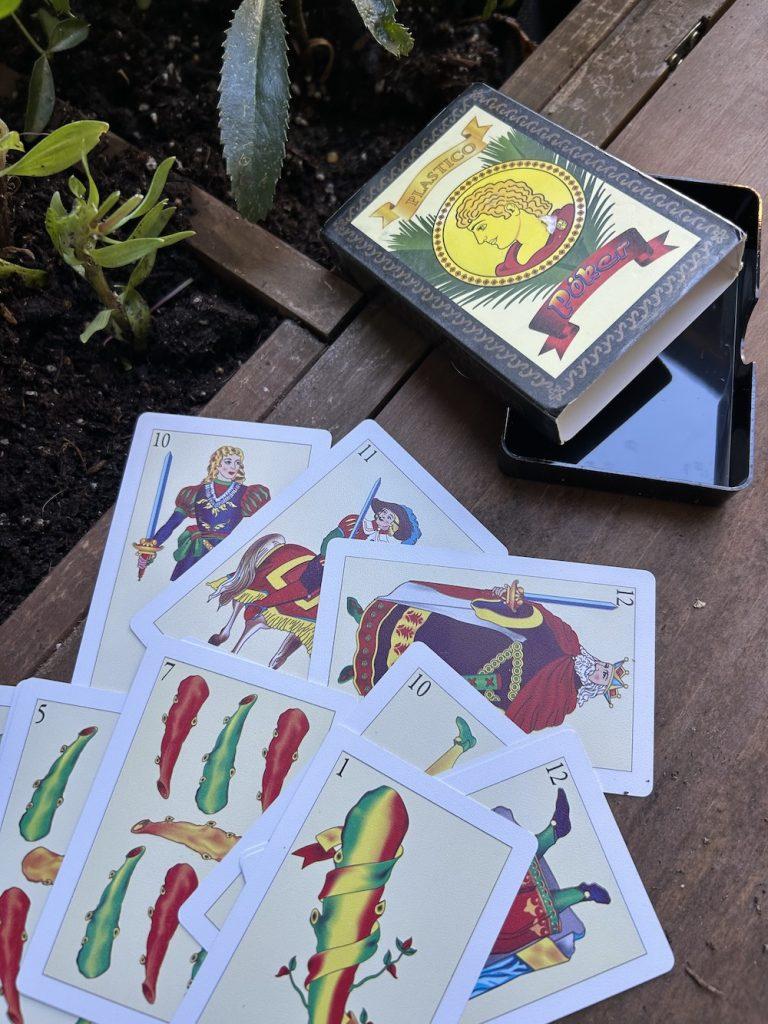
The cards I purchased on the beach don’t seem to have the ornate borders but I love them all the same!
Traditional Mexican card games rely heavily on this deck structure, making it a foundational piece of Latin American gaming culture. The Mexican card deck can be used to play games like Brisca, Escoba, and Conquian.
Here’s more about the Baraja Española – and why every card player should have at least one deck in their collection.
Where to Buy a Mexican/Spanish Card Deck
The first thing you’ll have to start with is to acquire a Mexican card deck.
Amazon has various affordable “Mexican poker cards,” and PlayingCardShop.eu has decks from all over the world.
Some adapt a regular 52-card deck by removing the 8s, 9s, and 10s from the deck – but this isn’t ideal because you’d still have to adapt the suits.
https://www.youtube.com/watch?v=rRlXqdMIUvU
(YouTube: Hermit of Visconti, Faisan Mexican Playing Cards for Trick-Taking Games)
Mexican vs French Decks
The main difference between Mexican and French playing card decks would be the suits and amount of cards.
According to World of Playing Cards, playing cards that had been made in Mexico became more popular in the 16th century due to the fact that other decks had to be imported. This made standard card decks more expensive – and subject to shipping delays.
As people traveled around the world, their card decks came with them – leading to the spread of games as far as people were willing to play them.
(Can you imagine being a seafarer and finding nobody else to play with at your end destination? We’re guessing that’s how humankind came up with Solitaire.)
Mexican card decks can be used for playing various other games like Brisca, Escoba, and Conquian.
Playing Brisca
Brisca is said to have evolved from either the French game Brusquembille, or from the Italian card game Bazzica. Traditionally, this version is played with a 40-card deck.
https://www.youtube.com/watch?v=qo76Cu9qPF4
(YouTube: How to play brisca)
In Brisca, the point of the game is collecting more points (via tricks) than your opponents.
According to the game’s rules explained here, “Before starting the game, all players will agree on the number of hands necessary to win the game, adding the amount agreed at the beginning to a pot which the winner or winning pair will take.”
Instead of simply bidding, brisca has allowed and accepted signals that players may use through the game to communicate – winking, for example, is the three of trumps; closing your eyes for a moment means that your hands has no trumps.
What if you sneeze mid-game?
In Brisca, the highest cards are the ace (11 points) and the three (10 points).
Playing Brisca Online
If you’d like to play Brisca and don’t have an appropriate card deck nearby, try some of these online options for free Brisca – single-and-multiplayer:
- Steam (Brisca): https://store.steampowered.com/app/3866010/Brisca/
- VIP Games: https://vipgames.com/brisca/
- Solitaire Paradise: https://www.solitaireparadise.com/games_list/brisca.html
- Ludoteka (Multiplayer): https://www.ludoteka.com/clasika/games?game=brisca&hizk=en
Escoba
Escoba is a game that’s meant for two to four players, and requires fishing rather than taking tricks.
Players are meant to consider cards from their hand against what’s played on the table. The goal is for players to reach 15 points with what’s in your hand.
The winner gets escoba – or a sweep – when leaving the table empty and capturing all the cards on the table.
Find the rules for Escoba here at Pagat.com.
Conquian
The name Conquian comes from the Spanish phrase “¿con quién?” which translates to “with who?”
Conquian is considered similar to the game of Rummy, and accepted to be its most likely originating ancestral game. According to Pagat, the earliest reference for the game dates back to 1800s Mexico City.
“Each player tries to form matched sets consisting of groups of three or four of a kind, or sequences of three or more cards of the same suit.” says Bicycle Cards.
Watch this video for how to play Conquian in action
https://www.youtube.com/watch?v=Vq00jSkm96I
(YouTube: How to Play Conquian)
Note, if the link is Amazon, it will include our ‘affiliate’ number. Thank you for your support. We do not affiliate with any other shops at this time.


