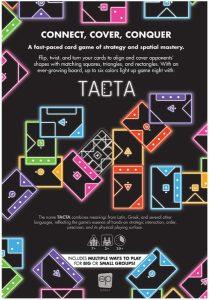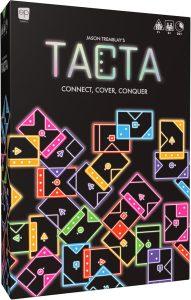


Master the Angles: The Ultimate Guide to Playing and Winning Tacta
If you love games with simple, elegant rules that hide surprisingly deep strategic choices, Tacta belongs on your table. Derived from the Latin word for “touched,” Tacta tasks players with shifting, flipping, and overlapping cards on an ever-evolving board. The concept is pure: secure your territory, bury your opponents’ progress, and read the geometry of the table to come out on top.
Whether you’re introducing the game to family night or looking to refine your competitive edge, here is everything you need to know about how to play, how to score, and the best tactical tidbits to defeat your opponents.
1. Setup: Holding Your Stack
Tacta supports up to 6 players out of the box (with variants for more).
-
The Decks: Each player chooses a color and takes their corresponding deck of 18 double-sided cards. Shuffle your cards. This prevents similar cards showing up in sequence.
-
No fanning: Shuffle your deck and keep it in a tight, face-up stack in your hand. Never fan or look through your deck. Throughout the game, you are strictly limited to playing only the top card or the bottom card of your stack.
- Starting the Game: Place the black-and-white Starting Card (marked with an “X”) in the center of the table. The player with the lowest dot value showing on either their top or bottom card goes first.
2. How to Play: The Dos and Don’ts of Placement
On your turn, you will choose either the top or bottom card from your stack and place it onto the playing area.
The Core Placement Rule
You must flip, rotate, or turn your card so that one of its geometric shapes perfectly overlaps and aligns with a matching shape already on the table. When placed correctly, the white borders on the cards should seamlessly connect, making the lines underneath look continuous.
Each side of the cards are mirror images of each other. When considering your play, do flip the card back and forth a bit – sometimes the mirror side will give you a tactical advantage.
The Essential “Dos” and “Don’ts”:
-
Do Cover Dots: You can place your card over an opponent’s card to hide their dots, or place blank shapes over dots (and vice-versa), as long as the geometric shapes align perfectly.
-
Don’t Touch Two Cards: On a standard turn, you can only overlap one card. You cannot bridge or overlap two separate cards at the same time.
-
The “No Legal Move” Exception: If it’s your turn and there are absolutely no legal matching shapes for you to overlap, you are allowed to place your card entirely on its own in the play area, completely isolated, without touching any other cards.
3. The Edge of the Playing Area: A Crucial Tactical Tidbit
Because Tacta has no physical board, the game board dynamically expands across whatever surface you are playing on (like a dining table or a coffee shop bistro table). This brings an incredible environmental mechanic into play: the edge of the playing area serves as a natural boundary.
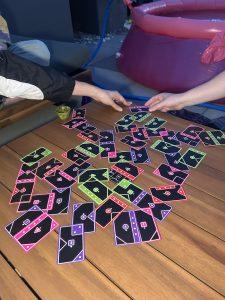 According to the rules, cards cannot overhang the edge of the table. Experienced players use this “edge of the playing area” as part of their play strategy. If you place a high-value card right against the physical edge of the table, you limit the angles from which your opponents can attack it. Because an opponent cannot place a card that extends past the table’s edge, it may become mathematically impossible for them to legally overlap and cover your dots. Using the table edge turns a vulnerable card into an un-attackable, point-scoring stronghold!
Flippin’ Check (see photo): When my friends and I play this game, we use the flip-check – if it looks like someone’s card is over the edge, you try to flip it from underneath. If it flips, it’s over the edge!
4. End of the Game & Scoring
Once every player has placed all 18 of their cards, the game immediately ends, and it’s time to count points.
-
Simple Math: Look at the mosaic of cards on the table. Every single visible dot matching your color is worth 1 point. If your dots were covered up by an opponent’s card, they are lost and worth nothing.
-
The Honor System: To keep things fair, players count their own dots, and then have the player to their right double-check their math.
-
Catching Cheaters (Illegal Cards): If players notice an illegally placed card during the end-of-game scoring, that card is simply removed from the table. However, to keep the game fair for innocent bystanders, any legal cards that were attached to the top of that illegal card still get to count their points!
-
Winning: The player with the most visible dots wins. If there’s a tie, you share the victory!
Counting those dots
OK so one of the biggest challenges in this game is counting the darn dots. It takes a long time! So here are some ideas that we’re floating to maybe make it easier:
- Use your phone. One friend took a picture of the finished game and counted their dots by enlarging the phone image and moving it side to side. I tried this and it didn’t really work for me.
- Using Gemini (or other AI): I took a picture of the finished game and uploaded it to my AI app – then asked it to count all the white dots on the purple cards (my cards). The results were totally wrong, but hey, I may have needed to massage the prompt a bit.
- Using Photoshop: This worked very well! I uploaded the photo to photoshop then marked each dot with a splooge of paint as I counted them. Great! But of course, not everyone has access to photoshop and it’s hard to do in the midst of game play!
- Subtract from 63. Finally, and I think this might be the best approach although I haven’t had a chance to test it out, the total possible dots for each colour is 63. So, start subtracting dots on your cards as they are covered. Or, you could use a pencil and paper and draw a tick every time a dot or dots are covered. At the end of the play, count your ticks and subtract from 63. Easy!
5. Interesting Gameplay Variants
If you want to mix things up, Tacta includes official alternate modes:
-
Limited Space: Each card features a small suit symbol (circle, square, or triangle) in the center. In this mode, you filter your deck and play three separate rounds, using only one suit per round. It’s perfect for small coffee tables.
-
Free Play Mode: Ditch the turns! A countdown of “3, 2, 1, GO!” starts a real-time frenzy where everyone places cards as fast as they can. The only catch? You are not allowed to place a card on top of your own color.
-
Sabotage Mode: Players split their decks by suits and pass one suit to the opponent on their left. You must play a deck mixed with your cards and your enemy’s cards—but you still only score points for your original color!
Tacta perfectly bridges the gap between casual card games and intense spatial puzzles. Keep your eyes on the table edges, protect your high-value dots, and start spinning those cards!
Shop
I purchased my deck from Rain City Games in Vancouver’s Chinatown. If you are looking for it online, you can find it on Amazon here.
Note: Purchases through our Amazon links support our affiliate program and this website.