
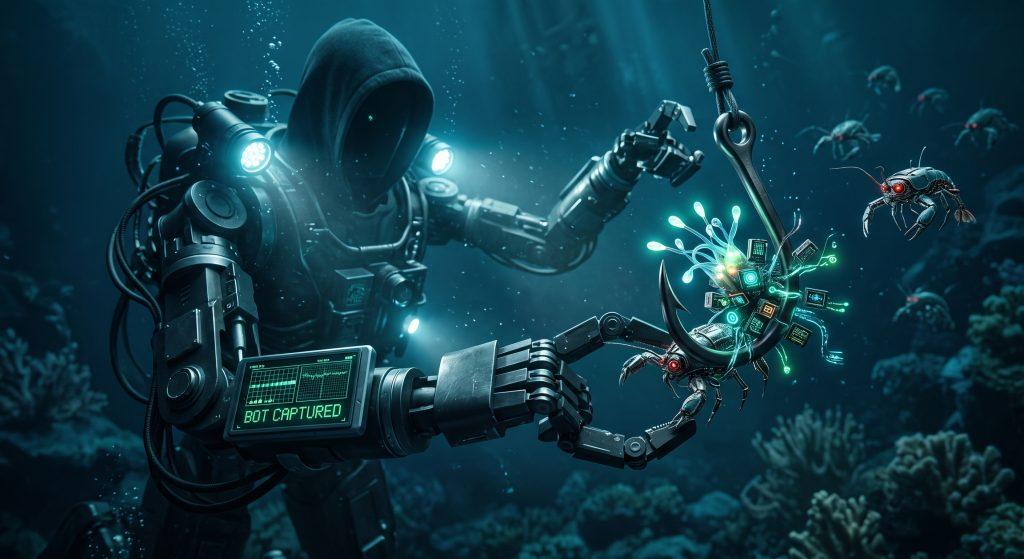
The Rise of Bot-Baiting: How Human E-Sports Pros Are Developing Psychological Tactics to Trick AI Opponents
by Alex J Coyne © Gifts for Card Players. August 2026
Bots have become commonplace on the internet, and most human users of the internet would agree that it’s not necessarily a good thing. Chatbots have led to a rise in what’s called AI psychosis, and it turns out that a large chunk of the internet today consists of bots that are all speaking to one another–or ragebaiting people into engagement for profit.
This has affected social media and creators alike. The impact of bots have also impacted the world of e-sports and cards, where they might provide an unfair advantage over fullly human players.
When you’re playing against a bot designed to predict your next move, it becomes a wholly unfair game for the humans involved … And that’s why players and platforms are coming up with inventive means to identify and stop bots on their servers.
It’s called “bot-baiting,” and it’s how players are beating the bots at their own game. Here’s a look at why the robots are taking over the internet, and how the internet is pushing back.
Why Bots?
A “bot” can be any intelligent internet script that’s designed to make its way through a task while it mimics human actions.
Sometimes it’s a chatbot that’s been designed to talk, though a bot could also be designed to do other things: liking, sharing, posting, or playing its way through a complicated video game or card play.
Anyone can create, adapt, or use an internet bot.
…and that’s exactly what should scare you about it.
Scammers have successfully used bots to impersonate people, affect online polls, or skew likes. Bots can harvest information, or successfully post as though it were human. Social media bots have been used to spark engagement or online fights–and you might even have encountered one before without knowing it.
Captcha is designed to identify specific human elements (such as a brief hesitation when moving your cursor to click) that would be hard or impossible for bots to replicate. However, Captcha only works for spotting bots at certain tasks–and gaming requires a different approach.
Boards like /r/MMORPG have discussed different systems to ditch bots; the “reverse Turing test” or “bot-baiting” aims to trick bots into revealing themselves through plays that would make a human react in certain ways (but bots react in others).
Stopping the Bots
When it comes to e-sports and card games, bots are designed to give players an unfair advantage–either by recommending the optimal move for the player, or by entirely playing the game for them.
Using bots for any online game is illegal, and could get players banned for life.
That doesn’t stop dishonest players from doing it, especially where games or tournaments are worth acclaim or money.
Reverse Turing tests attempt to trick bots into revealing themselves as non-human.
arXiv hosts the academic research behind these tests
Can you successfully pretend to be a chatbot?
Baiting the Bot
According to Splunk, bots can be countered with “machine learning and digital fingerprinting” to boot any bots from a gaming server.
These techniques could point to any specific behaviours that bots might do that humans don’t, and the other way around.
CardsRealm.co says that timing may expose actions that are scripted, and repeated move sequences may also show bot-like patterns.
Players who suspect they might be playing against a computer opponent would, if they’ve played enough humans, be able to spot when something just seems … Off. (Yes, like the black cat walking by twice in The Matrix.)
Simple human observation is also a useful way to identify bots and cheats, says this paper from the University of Delaware. If something feels like it might be suspicious for a human, there could be probable cause to check out this account further.
Here are some examples.
Example 1: The “Absurd Play” (Poker & Card Strategy)
In online poker or strategy card games, an AI opponent is usually running on hyper-optimized algorithms designed to calculate the exact, mathematically perfect move every single time. It expects you to play like a rational human—or at least a human trying to win.
To bait the bot, a human pro will deliberately make a completely nonsensical move. They might throw down an irrationally weak card, fold a winning hand, or shove all-in on an impossible bluff that breaks every known strategic rule.
-
How the human reacts: A real person gets confused, pauses, reads it as a psychological bluff or a mistake, and adapts their strategy.
-
How the bot gets exposed: The bot’s script encounters an input that breaks its decision tree. It either responds instantly with zero hesitation—revealing frame-perfect, automated execution—or stumbles into a rigid, repetitive loop because it lacks the capacity to process human absurdity.
Example 2: The Environmental Trap (MMORPGs & Esports)
Bots in multiplayer online games rely heavily on scripted navigation routes (waypoints) and strict conditional triggers—for instance: if an enemy appears in radius X, attack, loot, and move to point Y.
Human players spot these bots by intentionally messing with the environment around them. A player might drop a tempting item just behind a wall, drag a lethal high-level monster into a bot’s path, or position a harmless decoy in a narrow doorway.
-
How the human reacts: A human player sees the threat or obstacle, adapts on the fly, skirts around it, or types something in the chat.
-
How the bot gets exposed: The bot blindly executes its code. It will walk relentlessly into a solid wall trying to reach the waypoint, attack a boss it has zero chance of defeating, or perform its loot sequence with mechanical, sub-second precision—oblivious to the trap it just walked into.
Example 3. The Min-Bet Feedback Loop (Forcing Algorithmic Errors)
The Tactic: In heads-up digital card games, a player continuously inputs the absolute minimum allowed bet or fold option across dozens of consecutive turns, regardless of hand strength.
How it Baits the Bot: Bots programmed around Game Theory Optimal (GTO) solvers rely on standard betting tiers (e.g., half-pot, full-pot) to calculate range advantages. Flooding the game state with tiny, mathematically absurd micro-bets forces the bot to process thousands of non-standard branch nodes in its decision tree. Unprepared bots will often default to a hardcoded baseline—such as repeatedly folding mid-tier hands or making rigid, linear raises—making their automated loops instantly obvious to a human player.
The “Min-Bet” Loop, and other tactics, are used not just to confuse the bot, but to force it into a predictable, non-optimal behavior pattern that allows the human to win hundreds of small pots without risk.
The human can also captures a recording of the dozens of identical, immediate, algorithmic reactions to the nonsense bets and submits this “behavioral fingerprint” as undeniable evidence of scripting. The end goal here is getting the cheat removed from the player pool permanently.
At its core, bot-baiting relies on throwing unexpected noise into a clean system. While AI can calculate optimal odds in milliseconds, it stumbles the second a human acts completely irrational—leaving a telltale digital footprint that gives the cheat away.
Would you be able to tell a bot from a human?