Did the Inventor of Roulette Really Kill Himself? Unpack the Dark Legends of the Devil’s Wheel
by Alex J Coyne © Gifts for Card Players
Roulette wheels are one of the most alluring games on the casino floor—there’s just something mesmerizing about the spinning wheel. But beneath that hypnotic motion lies a shadow. Most people have heard a couple of reasons why roulette has better odds, but have you ever stopped to think about the dark price allegedly paid for its creation?
Some say there’s a sinister origin story to one of the most popular casino games, involving madness, obsession, and a literal deal with the Prince of Darkness. If you add up all the numbers on a roulette wheel, you’ll end up in a place you’d never guess …
Blaise Pascal: The Holy Man’s Accidental Demon
The story begins with Blaise Pascal, a brilliant 17th-century French mathematician and philosopher. Pascal is famous for the Pascaline (1642) —an early mechanical calculator—but his greatest obsession was something far more impossible: The Perpetual Motion Machine.
Pascal was a deeply religious man, yet he spent his life trying to “play God” by creating a machine that could run forever without an energy source. In classical physics, the First Law of Thermodynamics states that energy can neither be created nor destroyed, only transformed. A perpetual motion machine, if successful, would essentially create energy from nothing or continuously convert energy without any loss, violating this fundamental law.
In the 1650′s, one of his failed attempts at this infinite loop resulted in a balanced, spinning wheel.
Since the wheel eventually comes to a stop, it was a failure of physics—but it became a triumph of gambling. There is a tragic irony here: the man who gave us “Pascal’s Wager” (the argument that one could bet on the existence of God) inadvertently birthed a machine that would become the centerpiece of the world’s densest “dens of sin.” Some legends even suggest the frustration of this “failed” creation contributed to the mental decline and reclusive nature of his final years. By the end of his short life (he died at 39), Pascal was physically frail and mentally fragile, becoming a reclusive ascetic. While he did not commit suicide, his life was marked by obsession and a profound, visible struggle with his own mind and faith.
The ‘666′ Calculation: The Devil’s Receipt
Why is roulette often referred to as “The Devil’s Game”? It isn’t just because of the lives ruined by high stakes.
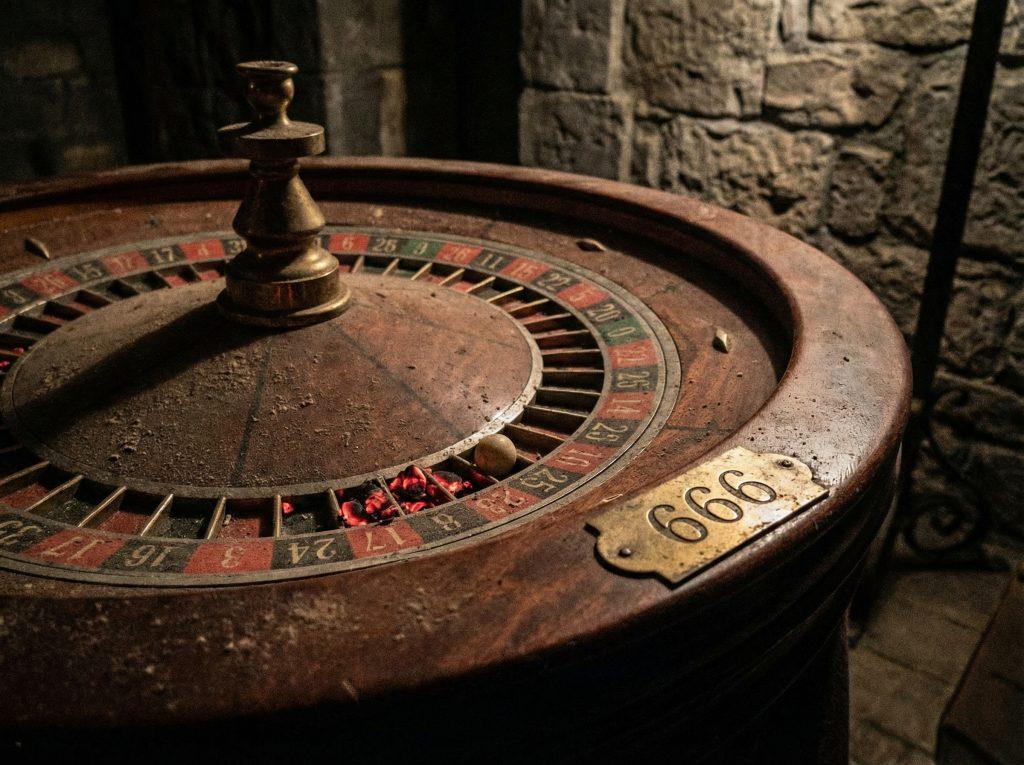
The nickname comes from a chilling mathematical reality: if you add up all the numbers on a standard roulette wheel—1 through 36—the sum equals exactly 666. In the Book of Revelation, this is the Number of the Beast.
For the superstitious, this isn’t a coincidence. It’s seen as a “receipt” for the soul of the game’s creator. While Ripleys notes there are multiple ways to add betting columns to find hidden patterns, the 666 total remains the most damning evidence for those who believe the wheel was designed with a darker purpose in mind.
The Bargain of François Blanc
While Pascal built the wheel, François Blanc is the man who unleashed it upon the world. Known as the “Magician of Homburg” and the founder of the Monte Carlo casino, Blanc’s success was so sudden and so immense that people couldn’t believe it was mere luck.
The rumour mill of the 1800s whispered a consistent story: Blanc had made a deal with the Devil.
The legend claims that in exchange for the secrets of the wheel and the keys to the Monte Carlo kingdom, Blanc traded his eternal soul. This story is a spin on the classic Faustian bargain—the same one attributed to blues player Robert Johnson at the crossroads.
Did the “inventor” kill himself? While Blanc died a wealthy man, the rumours of a “curse” followed the game’s lineage. The dark legend suggests that anyone who tries to truly “master” the wheel—to find the pattern in the chaos—eventually loses their mind. The wheel, after all, is a perpetual motion machine of a different kind: it perpetually moves money from the pockets of the desperate to the coffers of the house. Fact Check: François Blanc did not kill himself. He died of natural causes in Switzerland in 1877, a extremely wealthy and successful man.
The Curse of the “Pattern”
Even today, the “ghosts” of these legends haunt the casino floor through modern superstitions.
-
“Hot” and “Cold” Numbers: Players often feel a number is “due,” as if the wheel has a memory or a plan. It doesn’t. That feeling is the same obsession that drove early inventors to madness. The spin is random, and online roulette maintains this using a Random Number Generator.
-
The Gambler’s Fallacy: Feeling like you’re “on a streak” is the wheel’s greatest trick. There are no patterns in roulette—only the cold, mathematical certainty that the house (and perhaps the Devil) always wins in the end. However many people successfully use betting systems that take advantage of ‘winning streaks’ so who really knows the truth. It’s a mysterious world!
Whether you believe in deals with demons or just the laws of probability, the roulette wheel remains a dark masterpiece of human ingenuity. Always bet carefully and responsibly—because when you play the Devil’s Game, the stakes might be higher than you think.